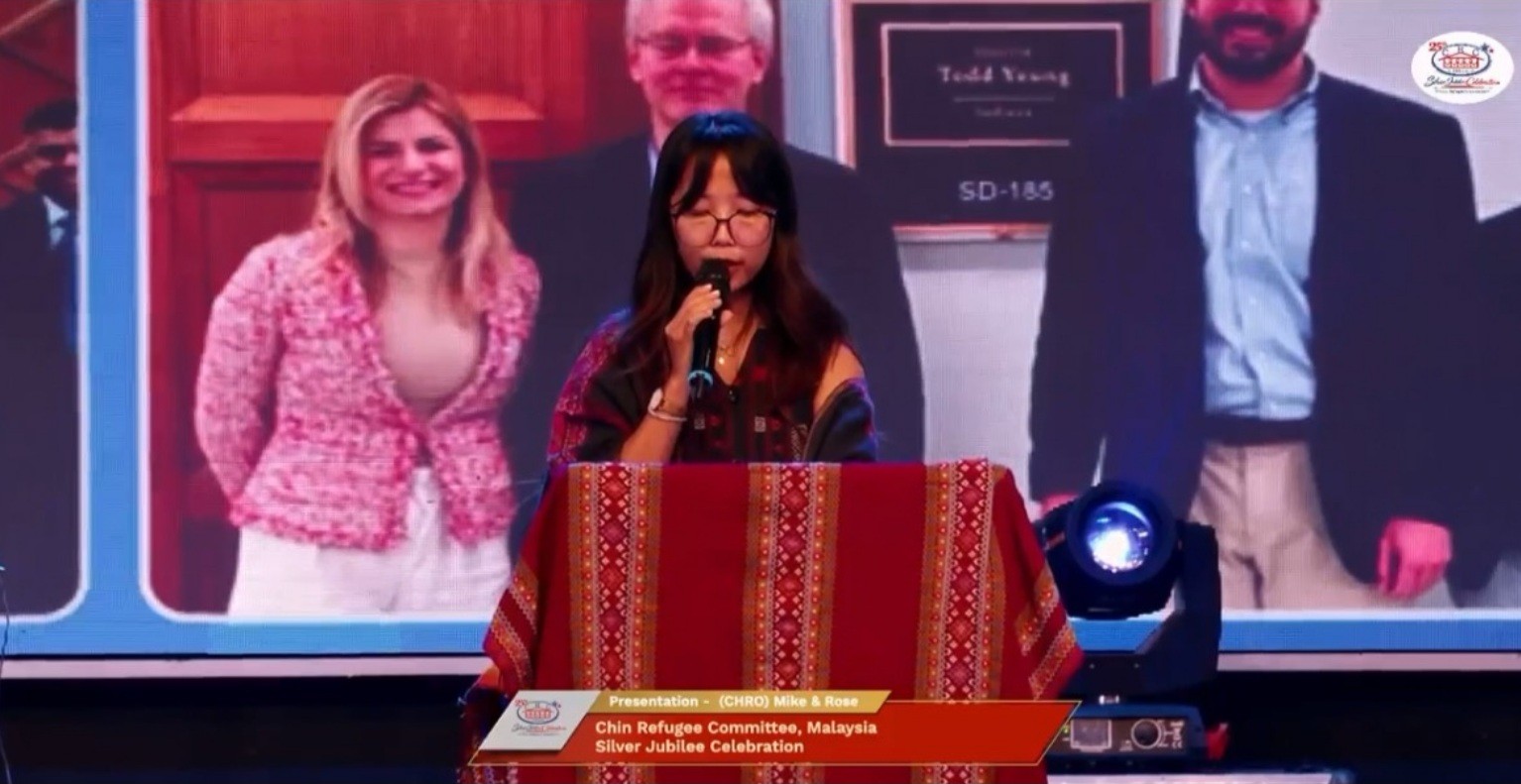
Note: The report is presented by Ms Rosemary, a staff member of CHRO.
27 May 2026 – Good morning, distinguished guests, respected leaders, friends, members of Chin Refugee Committee, representatives from UNHCR, diplomatic missions, civil society organizations, and our beloved Chin community. On behalf of the Chin Human Rights Organization, I would first like to congratulate the Chin Refugee Committee on its 25th anniversary. 25 years is not simply the passing of time.
It represents 25 years of survival, sacrifice, protection, solidarity, and service to our people during some of the darkest chapters in our history. Today we gather not only to celebrate an institution, but to honor a community that refused to disappear. For many Chin families, the story of displacement did not begin only after the 2021 coup.
It began decades earlier through cycles of militarization, religious persecution, forced labor, hunger, and displacement. CRC emerged during those difficult years to provide protection, dignity, and hope for Chin refugees living far from home. Over the last four months alone, from January to April 2026, CHRO documented 121 civilian casualties in Chin state and surrounding areas, including 42 deaths and 79 injuries.
Twenty-four children were directly impacted through killings and injuries. More than 200 civilian structures, including homes, churches, school, and public infrastructure, were damaged or destroyed. During this same period, we documented 269 separate airstrikes across Chin areas with military operations testifying dramatically in April.
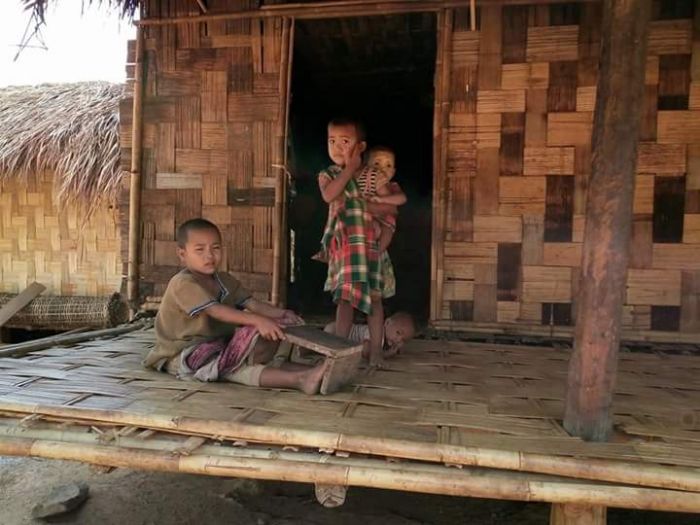
Behind every number is a human story. A child who no longer sleeps without fear of aircraft overhead. A pastor conducting worship beneath the sounds of jets.
A mother carrying her children across mountains into displacement. A community rebuilding the same church for the third or fourth time. This is the reality our people continue to live through.
The Myanmar military is now deploying one of the largest and most aggressive operations Chin has seen since the coup began. Over 22 battalions have reportedly been mobilized for operations in northern Chin state. Among them is Light Infantry Division 77, one of the military’s most notorious elite combat divisions, deployed in the near full force with approximately 10 battalions.
Additional battalions have been reinforced into the area, supported by continuous air operations. At the same time, unknown numbers of troops continue to mass along the southern Chin-Magway border in what appears to be the border strategy to choke the Chin state from multiple directions. Why are they doing this? Partly because the Chin state has been both symbolically and strategically important.
In 2021, the military publicly declared that it would crush resistance in Chin state within two weeks. Instead, the Chin community resisted with extraordinary courage and determination. Over time, the military lost effective control over most of the state and was pushed out from the large areas it once claimed to dominate.
That defeat was deeply humiliating for the regime. Today, offensives are not only military operations, they are also political operations. The junta wants to reverse that humiliation and regain strategic leverage, including with neighboring India, by protecting an image that has restored control and authority over Chin state.
At the same time, the military attempted to stage what is described as elections. But what the world witnessed was not democratic reform. It was a political performance designed to manufacture legitimacy while air strikes and attacks against civilians continue in parallel.
During the election period, CHRO documented escalating aerial bombardments, destruction of churches and schools, executions of displaced civilians, arbitrary arrests, and the laying of landmines in civilian areas. Turnout collapsed even in areas where pooling was allowed. Entire townships were cancelled days before voting because simply the military did not control their ground in reality.
The regime failed to convince the people of Myanmar, and it failed to convince the international community. This is why accountability matters. Over the past year, CHRO has expanded work on universal jurisdiction and international accountability.
We have worked with international legal experts, survivor communities, and documentation networks to help close what we often describe as a less accountability gap. Because it’s in Myanmar, impunity is not accidental. It is systematic.
Universal jurisdiction allows national courts to pursue accountability for atrocity crimes regardless of where they were committed. It sends an important message that military leaders cannot hide forever behind sovereignty, diplomacy, or political power. This year, CHRO led a delegation to Timor-Leste to submit a complaint concerning war crimes, crimes against humanity committed against civilians.
During that visit, our delegation also held meetings with senior Timorese leaders, including President Johe Ramos Orta. The filing generated significant international attention, even contributing to diplomatic tensions between Myanmar and Timor-Leste. But it also demonstrates something very important.
The struggle for justice is no longer confined within Myanmar borders. At the United Nations Human Rights Council in Geneva, CHRO also engaged members of states and contributed recommendations into negotiations surrounding the Human Rights Council, drafted resolutions on Myanmar, including provisions concerning accountability and civilian protection.
During advocacy engagements in Europe, CHRO met with members of the European Parliament, including members from the Christian Democratic Bloc, to advocate for stronger action concerning the Rohingya and other ethnic and religious minorities in Myanmar.
These efforts contributed to broader parliamentary support that resulted in the adoption of the European Parliament resolution on Myanmar. In Australia, CHRO provided testimony before the Senate Foreign Affairs Defense Trade Reference Committee concerning democracy and human rights in Myanmar.
We also participated in international media engagement, including podcasts with USCIRF and Inside Myanmar, discussing religious persecution, universal jurisdiction, and the growing threat posed by landmines, area welfare against civilians.
But when we talk about democracy, diplomacy, and accountability, we must never lose sight of the human reality. The burden of the crisis continues to fall heavily on ordinary communities. This is where an organization like CRC is so important.
For 25 years, CRC has stood alongside the displaced Chin community, helping families survive detention, statelessness, poverty, and certainty.
CRC helped create pathways for education, health care, protection, and dignity at times when our people had almost nothing. Even today, amidst conflict and displacement, Chin communities continue to keep education alive, continue worshiping, continue organizing, continue caring for one another, and continue believing in a future beyond violence.
Resilience is not weakness, it is resistance. And despite the devastating losses and setbacks, our people continue to endure. I would like to conclude with this.
The regime is losing the war, not because the suffering is small. It is immense, not because the military is weak. It remains extremely dangerous, but because it has fundamentally failed in its political objectives.
It failed to break the will of the people. It failed to regain legitimacy through sham elections. It failed to convince the international community that military rule can bring stability or peace.
And despite overwhelming violence, communities across Myanmar continue to demand dignity, freedom, federal democracy, and justice. The Chin people have already survived decades of persecution, displacement, and attempts at erasure. We are still here.
And as long as the communities continue protecting one another, educating the next generation, documenting the truth, and refusing to surrender their humanity, there remains hope. Thank you.