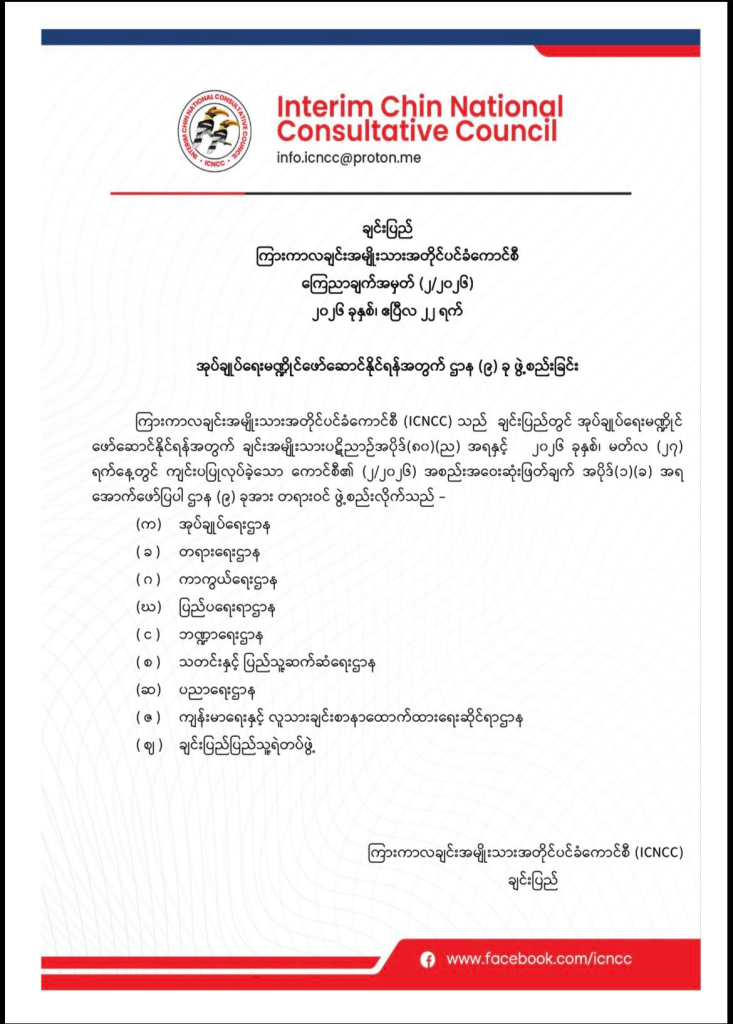
23 April 2026 – The Interim Chin National Consultative Council (ICNCC) has announced the formation of nine key departments as part of efforts to build a structured governance system in Chin State amid ongoing conflict in Myanmar.
In Announcement No. (2/2026), released on 22 April, the ICNCC said the move follows a resolution adopted during its 27 March meeting and aligns with the provisions of the Chin National Charter, a political framework guiding Chin self-governance.
The newly established departments cover core state functions, including Administration, Justice, Defence, Foreign Affairs, Finance, Information and Public Relations, Education, Health and Humanitarian Affairs, as well as the Chin State People’s Police Force. Further details on staffing, operational structures, and timelines have yet to be disclosed.
The Interim Chin National Consultative Council is a broad-based platform that brings together representatives from Chin ethnic groups, elected lawmakers, political parties, members of the Civil Disobedience Movement, and civil society organisations. It has been working to lay the foundations for a unified political and administrative system in Chin State following Myanmar’s 2021 military coup.
The announcement comes amid parallel governance efforts in the region. The Chinland Council, formed by the Chin National Front/Chin National Army, elected representatives, and local defence forces, continues to operate its own administrative structures and deliver public services in areas under its control.
Observers note that while both bodies share the broader goal of self-determination and resistance to military rule, differences in structure and alignment have led to the emergence of dual governance systems in Chin State. Recent reporting by Chin-focused media highlights ongoing discussions around coordination, institutional development, and the possibility of greater unity among Chin political actors.
The ICNCC’s latest move is seen as part of a wider push to formalize governance institutions, improve service delivery, and prepare administrative frameworks for a post-conflict future, even as security challenges and humanitarian needs remain acute across the state. – Reporting by Daniel