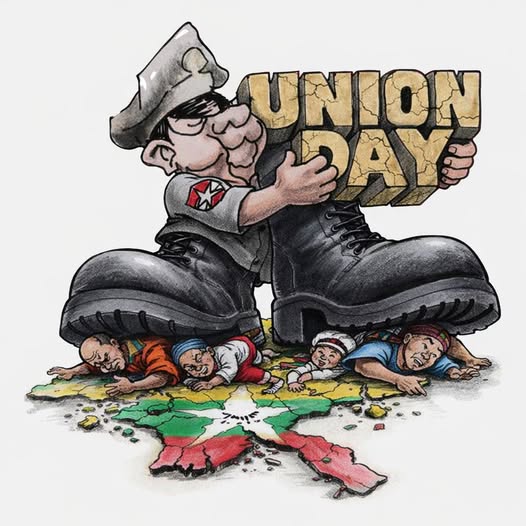
12 February 2026 (Chinland Guardian’s Editorial) – The cartoon tells a story that words alone struggle to capture. A military strongman clutches the cracked and crumbling letters of “Union Day” with affection, as if embracing something precious. Yet beneath his oversized boots lie the crushed bodies of ethnic peoples, their identities flattened, their dignity trampled. Below them all is the shattered map of Myanmar itself—fractured, broken, barely holding together.
This is the Union as it exists today under military rule: embraced in rhetoric, destroyed in reality.
Union Day, commemorated on February 12, marks one of the most sacred promises in Myanmar’s history. It recalls the Panglong Agreement of 1947, when General Aung San and ethnic leaders agreed to build a Union based not on domination, but on equality. It was a revolutionary idea—that unity could be built through consent rather than coercion, through mutual respect rather than fear.
For ethnic peoples like the Chin, this promise represented hope. It offered the possibility of belonging without surrendering identity. It offered dignity within unity.
But that promise was never fully honored.
Instead, successive military regimes redefined the Union not as a partnership, but as a hierarchy. Unity became something enforced, not negotiated. The military declared itself the sole guardian of national integrity, while systematically denying ethnic nationalities the equality that Panglong had envisioned.
The result has been decades of conflict, mistrust, and suffering.
Since the coup of February 1, 2021, this contradiction has reached its most violent expression.
The military claims to preserve the Union. Yet it bombs villages. It burns homes. It destroys churches. It forces hundreds of thousands to flee their ancestral lands. It imprisons elected leaders. It wages war not against foreign enemies, but against its own people.
What kind of Union must be preserved through airstrikes on civilians?
What kind of unity requires the destruction of entire communities?
The cartoon captures this hypocrisy with devastating clarity. The boots represent not protection, but oppression. The shattered map reflects not accidental fragmentation, but deliberate destruction.
And the cracked “Union Day” letters reveal the truth: the military embraces the symbol while destroying its meaning.
Yet beneath this destruction, something profound has emerged.
For the first time in modern history, the majority Bamar population and ethnic nationalities across Myanmar are united not by force, but by shared conviction. They have come to understand what ethnic peoples have long known: that military rule does not preserve the Union—it destroys it.
This shared realization is transformative.
For decades, ethnic nationalities called for federal democracy—a system in which power is shared, diversity is respected, and all peoples have equal voice in shaping their future. These calls were often dismissed, misunderstood, or ignored by those in the center.
But the coup changed everything.
The military’s violence did not discriminate between ethnic and majority populations. It revealed a fundamental truth: military rule threatens everyone.
In cities and villages alike, people rose up not merely to restore the past, but to demand a different future. They did not call for a return to centralized control. They called for federal democracy.
This is not a coincidence. It is the natural result of lived experience.
People across Myanmar now recognize that unity cannot be imposed from above. It must be built from below, through equality, consent, and mutual respect.
Federal democracy is not simply a political arrangement. It is a moral vision. It affirms that diversity is not a weakness, but a strength. It recognizes that unity does not require uniformity. It acknowledges that true stability comes not from domination, but from justice.
The Chin people have long believed this.
For decades, Chin communities endured marginalization, neglect, and abuse under military rule. Yet they never abandoned the idea of a genuine Union. They did not seek separation. They sought equality.
Today, that aspiration is shared by millions across Myanmar.
This is the military’s greatest fear.
The military thrives on division. It has long portrayed itself as the only force capable of holding the country together. But when people unite around the principles of federal democracy, that narrative collapses.
The cartoon reflects this moment of transition.
The military figure clings desperately to the cracked letters of “Union Day,” as if trying to preserve something slipping away. But the cracks are already there. They cannot be hidden. They cannot be repaired through force.
The Union, as defined by military domination, is breaking apart.
But another Union is being imagined.
This new vision is not imposed by generals. It is shaped by the people themselves. It is rooted in shared suffering and shared hope. It is guided by the understanding that unity must be voluntary, not forced.
This is why the military resorts to violence.
Violence is the last refuge of illegitimacy.
It is easier to crush bodies than to command loyalty. It is easier to destroy villages than to earn trust. It is easier to embrace symbols than to uphold their meaning.
But violence cannot create unity.
It can only deepen division.
Every bomb dropped on a civilian village weakens the military’s claim to protect the Union. Every act of repression strengthens the people’s determination to build something better.
The shattered map in the cartoon is not just a symbol of destruction. It is also a warning—and a choice.
Myanmar stands at a crossroads.
One path leads to continued domination, endless conflict, and the slow disintegration of the country itself.
The other path leads to federal democracy, shared power, and genuine unity.
The military’s boots may appear powerful, but they stand on unstable ground. They cannot crush the human desire for dignity. They cannot extinguish the belief in equality. They cannot stop the emergence of a new political consciousness shared by both majority and minority communities.
This consciousness is the foundation of Myanmar’s future.
Union Day was meant to celebrate unity built on equality.
Today, the military embraces the word while destroying its essence.
But the meaning of Union Day does not belong to generals.
It belongs to the people.
And across Myanmar—in Chinland, in the plains, in the hills, and in the cities—the people are reclaiming it.
They are redefining the Union not as something imposed by force, but as something sustained by justice.
The cracked letters may still be held in the hands of those who fear losing power.
But the future of the Union lives elsewhere.
It lives in the shared struggle for federal democracy.
It lives in the courage of those who refuse to accept oppression.
It lives in the belief that unity, once broken, can be rebuilt—not through boots and bullets, but through equality and freedom.
And that is a Union worth embracing.#